The BRT Explorer at AES AVARiG 2026
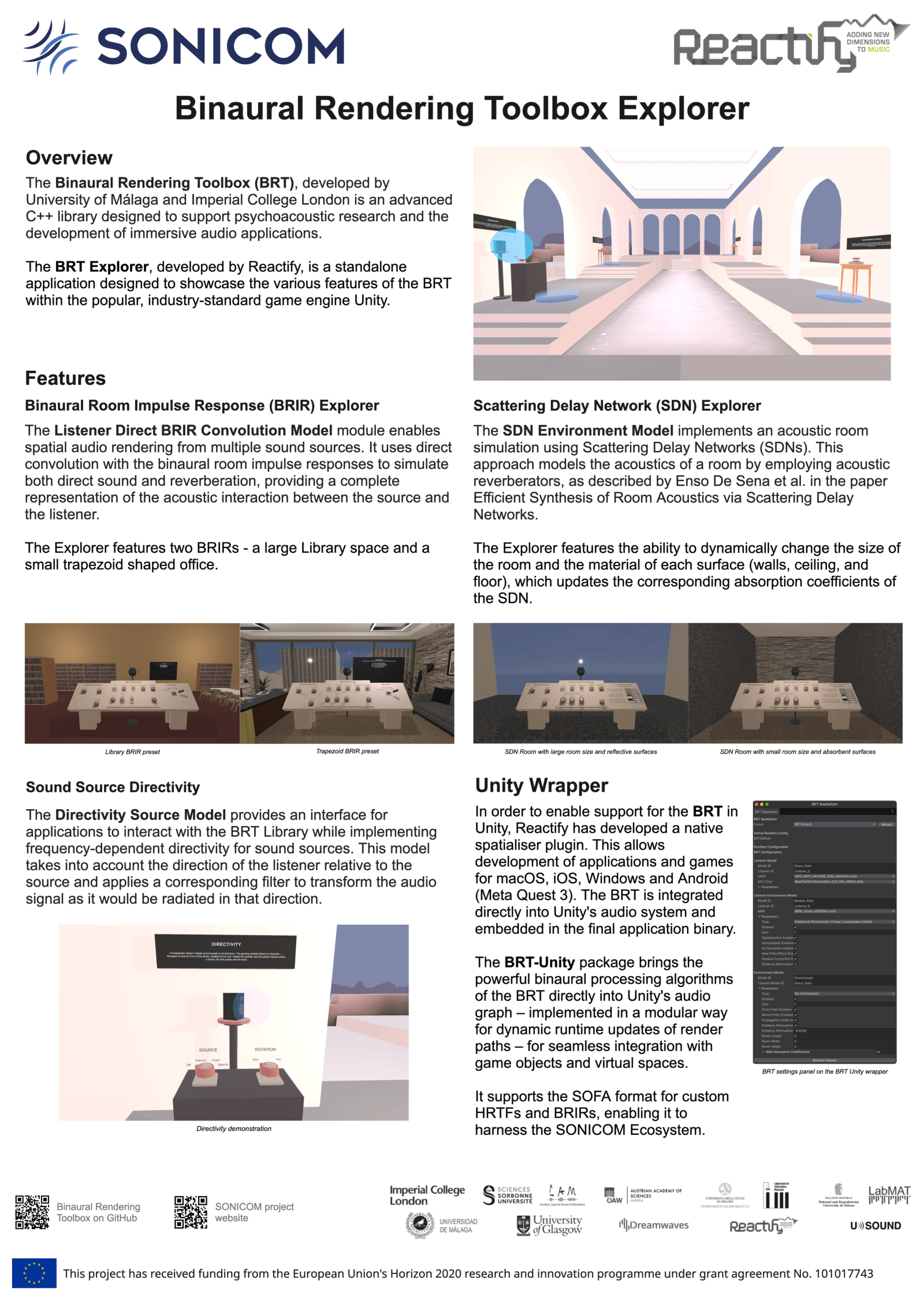
We spent the end of June in Paris at AES AVARiG 2026 — the 6th International Conference on Audio for Virtual and Augmented Reality and Immersive Games — showing the BRT Explorer, built as part of the SONICOM project.
It ran from 30 June to 3 July across two venues: Sorbonne University’s Jussieu campus for the first half, then IRCAM/STMS for the second. This was the first time AVAR has been held in Europe, and the first edition to merge with the audio-for-gaming community under the AES Technical Committee on Immersive Media and Gaming — which made for a noticeably broader room than a pure spatial-audio conference usually gets.
It came immediately after the final SONICOM project meeting, which gave the trip a certain symmetry: five years of work wrapping up one day, and being demonstrated to the wider research community the next.
What the BRT is
The Binaural Rendering Toolbox is a C++ library developed by the University of Málaga and Imperial College London, designed to support psychoacoustic research and the development of immersive audio applications. It is deliberately modular — you assemble a rendering path from components rather than being handed a single fixed pipeline, which is what makes it useful for research where the pipeline itself is the thing under investigation.
The BRT Explorer is a standalone application we built to showcase what the library can do, inside Unity. Rather than a paper describing the modules, it is a room you can walk around, with the parameters exposed on a control table in front of you.
What it demonstrates
Binaural Room Impulse Response (BRIR) rendering. The Listener Direct BRIR Convolution Model renders multiple sound sources by direct convolution with binaural room impulse responses, capturing both direct sound and reverberation — the full acoustic interaction between source and listener. The Explorer ships two contrasting spaces: a large library and a small trapezoidal office.
Scattering Delay Networks. The SDN Environment Model simulates room acoustics using a network of acoustic reverberators, following De Sena et al.’s work on efficient synthesis of room acoustics. In the Explorer you can change the room’s dimensions and the material of each surface — walls, ceiling and floor independently — and hear the absorption coefficients update as you do.
Sound source directivity. Real sources do not radiate equally in all directions. The Directivity Source Model applies a frequency-dependent filter based on where the listener is relative to the source, so a voice or an instrument changes character as you move around behind it.
The Unity wrapper
Getting the BRT into Unity meant writing a native spatialiser plugin, which we developed for macOS, iOS, Windows and Android — including Meta Quest 3. The BRT is integrated directly into Unity’s audio graph and embedded in the final application binary, so there is no external dependency at runtime.
We built it modularly so render paths can be updated dynamically at runtime rather than being fixed at scene load, which matters for exactly the kind of A/B comparison this research depends on. It reads the SOFA format for custom HRTFs and BRIRs, so it can draw directly on the SONICOM Ecosystem’s datasets.
The package is open source, at reactify/BRT-Unity.
The poster
Try it on a headset
The build below is the SONICOM networked VR demo, which runs on the same BRT Unity integration described above — so it is the quickest way to hear the toolbox working on a headset rather than reading about it.
Built for Meta Quest — Quest 1, 2, 3, 3S and Pro. It is not on the Meta store, so it needs sideloading: enable Developer Mode on the headset, then install with SideQuest or `adb install build.apk`.
SONICOM has received funding from the European Union’s Horizon 2020 research and innovation programme under grant agreement No. 101017743.